Sweden tour
VenueVenues to be confirmedInvite the production to your city or school.
TimeTo be confirmedContactfed@artednet.com
 ← All shows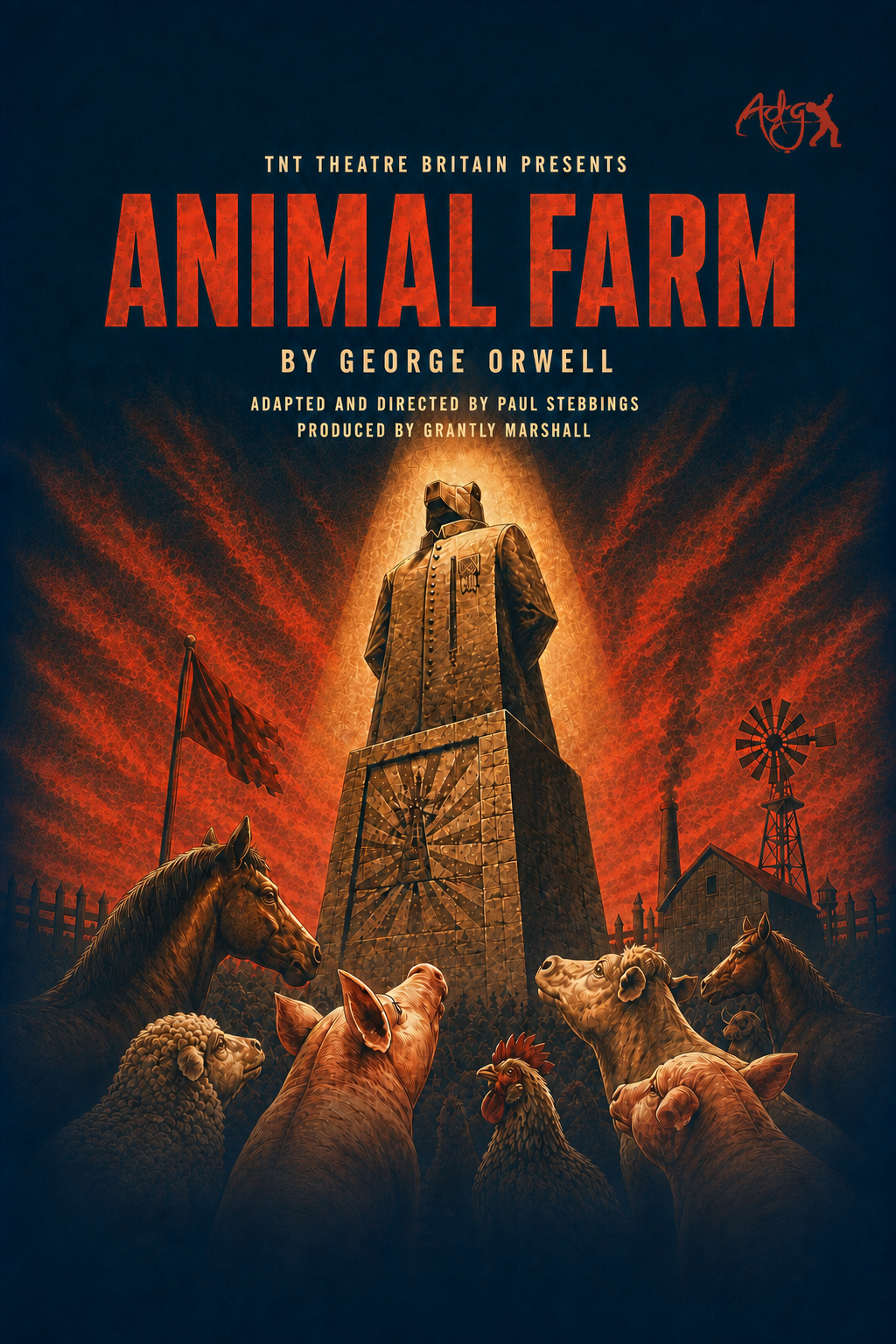
TNT Theatre Britain
Company
About the production
Paul Stebbings first dramatised George Orwell’s masterpiece, Animal Farm, several years ago for Théâtre du Héron in Nantes. The adaptation proved highly successful, touring for multiple seasons, and in 2023 the play text received the award for Best Script in London’s small theatre sector.
Now Paul returns to the project as both writer and director, developing the production in new and exciting ways. His approach is influenced by the success of his acclaimed adaptation of Orwell’s 1984, which toured extensively across Europe for three years until spring 2026.
Orwell’s powerful farm allegory speaks differently to each generation. Too often, the novel is regarded merely as a historical curiosity or a straightforward condemnation of Stalin’s betrayal of the Russian Revolution. Yet Animal Farm is far more complex than that, and Orwell himself was dismayed to see his work used as an attack on the ideals of equality and social justice that he personally believed in.
The ending of the book is particularly important and is frequently overlooked. Dictatorship is not the final destination of Manor Farm. The true culmination occurs when the pigs and the businessmen become indistinguishable from one another, united not by ideology but by profit. Brutal power on Manor Farm serves a single purpose: wealth and comfort for those in control. Former enemies become partners in greed.
Meanwhile, the farm animals labour without reward, terrorised by savage dogs and forced to sing hymns of praise to hypocritical pigs who mock their idealism while demanding endless sacrifice. Like Boxer the Horse, they work until they collapse. In our own time, Animal Farm can be viewed as a companion piece to 1984: a portrait of societies where the language of equality conceals the ruthless pursuit of power and wealth, and where hopes for a fairer future risk becoming nightmares.
Yet despite the darkness of Orwell’s vision, Animal Farm remains a work of great warmth, humour and humanity. The animals care for one another, strive for justice and maintain their dignity even when confronted with the worst aspects of human behaviour, reflected through the animal kingdom.
Napoleon, the swinish dictator and betrayer of the Revolution, may believe himself to be the greatest animal alive. Yet it is Boxer, the noble and selfless horse, who stands as the story’s true hero and greatest creation. Nothing Napoleon and his cronies can do can take away Boxer’s dignity. Nothing the pigs and farmers can do can entirely destroy humanity’s sense of justice.
Or can they?
Does every struggle for a better world inevitably end in selfishness and corruption? Or is idealism still possible, even in our own cynical age?
These are the questions Orwell raises, and the TNT production leaves them for the audience to answer. As spectators laugh and cry through this remarkable story, each of us must decide whether believing in a better world is a weakness—or our greatest strength.
On stage
Open any photograph to see it in full.
Your review
This is a new production. Would you like to be the first to leave a review?
info@artednet.comTour calendar
Tickets: SEK 350 Adults/SEK 200 StudentsDiscount possible for large groups
Tickets: 40 LEU / studentTeachers enter free
Book Here ↗Tickets: 8 EUR / studentTeachers enter free
Book Here ↗Tickets: €8 / studentTeachers enter free
Book Here ↗Tickets: €10 / studentTeachers enter free - Discounts possible for large groups For groups of 100 students of more we offer 1€ discount For groups of 200 students of more we offer 2€ discount
Tickets: €13 / studentTeachers enter free
Tickets: €13 / studentTeachers enter free / discount for large groups (11€ groups > 100 e 10€ groups> 200)
Tickets: €14 students · €30 adults
Tickets: DKK 120 students · DKK 250 adultsTeachers pay the applicable adult ticket price